A seemingly common Python interview question, but a crucial concept behind it. Let’s take a quick look.
In Python, we use the == operator to check if two objects have the same elements. 
In other words, it checks for equality of the values.
Whereas, the is operator checks if the 2 objects refer or point to the same object.
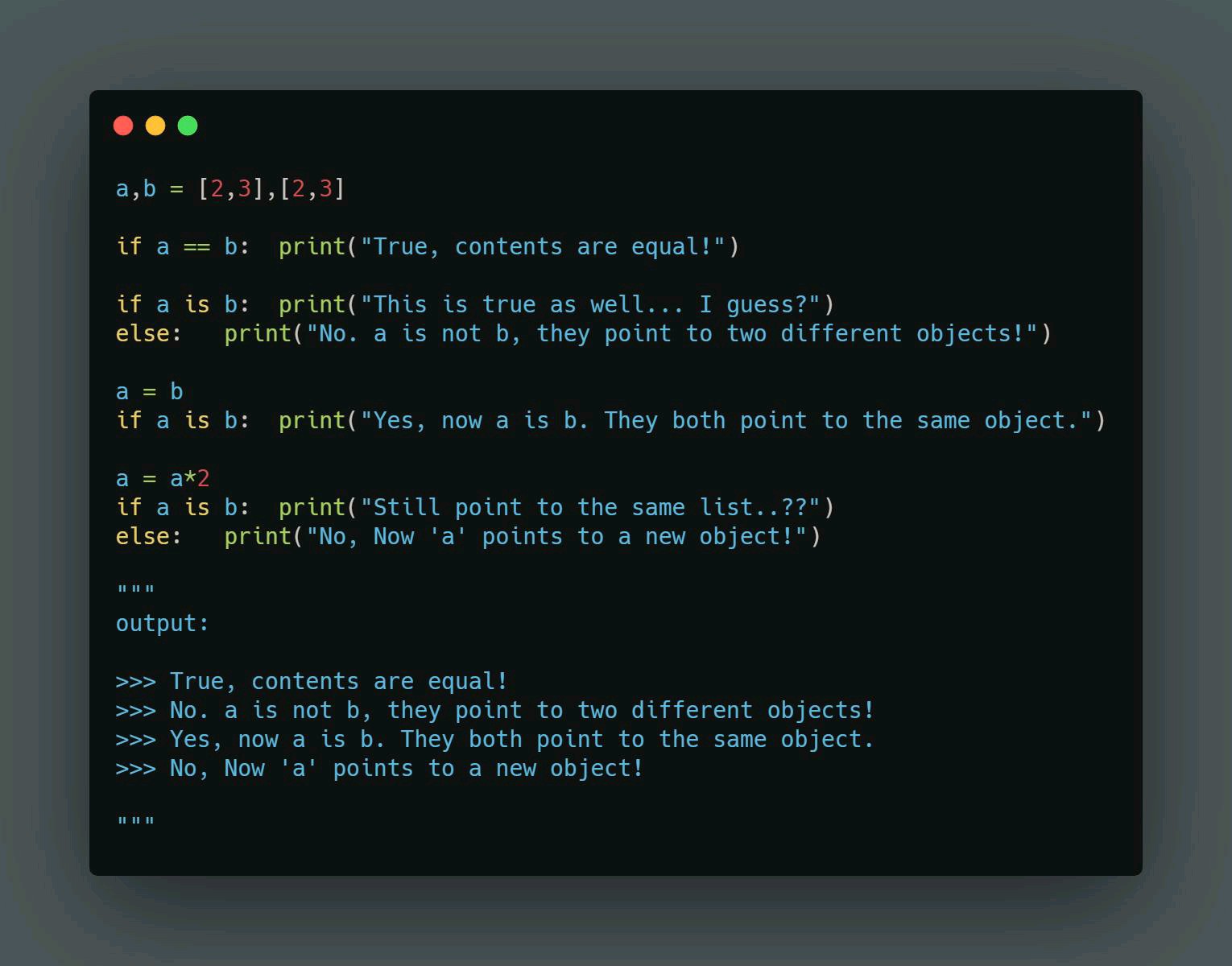
Take a look at the code in the image.
I initialize 2 lists a and b with the same elements. So, when I check if a == b, it returns True.
But, a is b returns False, as they are pointing or referring to two different objects in the memory.
This can also be verified by checking the id() of the lists, which will be different in this case.
Now, when I make a = b explicitly, I am essentially making them point to the same object.
So, the is operator will return True, as the id() will be the same for both a and b.
And in the last step, when I re assign an object to list a, it doesn’t apply to b, so the id are different again. Neither == nor is will hold True now.
Now, a question for you. What if I appended a new value to the list a rather than re assigning in the last step above?
What will the is operator return in that case - True or False?
#python #datascience #machinelearning